Contact center AI technology brings machine learning, natural language processing (NLP), automation, and analytics into customer support operations. It helps teams respond faster, personalize service at scale, reduce repetitive work, and improve consistency across channels. It can also elevate the agent experience by turning complex workflows into guided, searchable, and measurable processes. An omnichannel contact center technology approach ensures these benefits are seamless across every communication channel.
When planning adoption, evaluating contact center AI technology pricing is an important step. Costs can vary depending on AI modules deployed, the number of agents, interaction volumes, and integration complexity. Understanding pricing upfront helps organizations make informed investment decisions, scale technology effectively, and ensure that AI initiatives deliver measurable improvements in customer experience, agent productivity, and overall operational performance.
This article explains what contact center AI is, where it delivers the most value, and how to adopt it in a way that protects customer trust while improving speed, quality, and operational efficiency. These capabilities illustrate how ai contact center solutions for enterprises are transforming customer engagement.
What “contact center AI” means in practice
In a modern contact center, AI typically shows up as a set of capabilities rather than a single tool. These can be deployed in self-service channels (like chat or voice bots) and in agent-assist workflows, enabling ai contact center companies to deliver better customer experiences.
- Conversational AI for chat and voice: understands intent, asks clarifying questions, and completes routine tasks.
- Agent assist: suggests responses, surfaces knowledge articles, and helps with call summaries and next steps.
- Intelligent routing: matches customers to the best agent based on intent, skills, sentiment, language, or priority.
- Workforce support: forecasting assistance, quality management automation, and performance insights.
- Speech and text analytics: converts conversations into structured data for insight, compliance, and coaching.
- Automation: triggers workflows such as refunds, password resets, appointment changes, or case creation.
The goal is straightforward: handle more interactions with the same (or better) customer experience by reducing friction for customers and cognitive load for agents, demonstrating the value of ai contact center software in enabling intelligent, efficient, and scalable contact center operations.
Top Contact Center AI Technology Solutions
Contact center AI technology leverages artificial intelligence, machine learning, natural language processing, and automation to enhance customer service. These technologies help organizations improve agent productivity, reduce operational costs, and deliver personalized, seamless customer experiences across multiple channels. Here are some of the leading contact center AI technology solutions:
1. Bright Pattern — Advanced AI Contact Center Technology

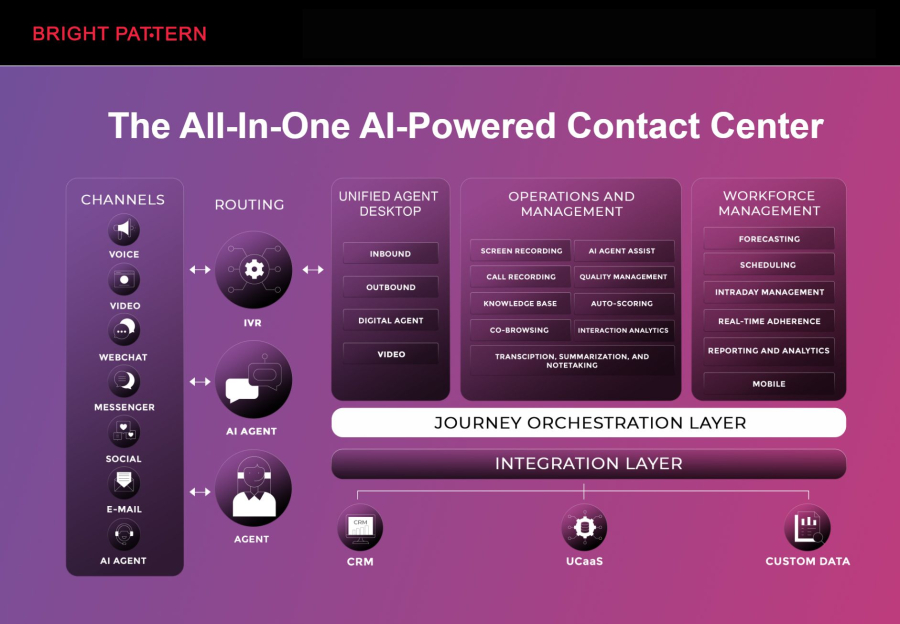
Bright Pattern provides a comprehensive AI contact center technology platform designed for enterprises seeking scalability, automation, and omnichannel engagement. Its technology helps businesses streamline operations, reduce handling times, and improve customer satisfaction.
Key Technology Features:
- AI Virtual Agents handle routine interactions such as FAQs, billing inquiries, order tracking, appointment scheduling, and returns, reducing agent workload and operational costs.
- Intelligent Routing directs customers to the right agent based on skills, sentiment, interaction history, and predicted needs, improving first-contact resolution.
- Omnichannel Support unifies voice, chat, SMS, email, messaging apps, and video in a single platform. Customers can switch channels seamlessly without losing conversation context.
- Real-Time Agent Assistance provides agents with suggested responses, knowledge articles, next-best actions, and sentiment insights, improving efficiency and accuracy.
- Workflow Automation automates repetitive tasks like ticket creation, follow-ups, notifications, and surveys.
- Predictive Analytics and Reporting track trends, sentiment, and agent performance to optimize workflows and staffing.
- Integration Services connect with CRM systems, workforce management tools, and marketing platforms for a seamless enterprise technology stack.
- Proactive Customer Engagement automates notifications for updates, promotions, or service issues, reducing inbound calls and enhancing satisfaction.
- Scalability and Security support global enterprises with compliance-ready features, data security, and disaster recovery.
- Commercial Value: Enterprises using Bright Pattern report reduced handling times, improved first-call resolution, and higher customer satisfaction, making it a strong investment for large-scale operations.
Bright Pattern’s AI technology enables enterprises to deliver intelligent, automated, and consistent customer experiences across all channels while optimizing operational efficiency.
2. Genesys Cloud CX Technology
Genesys Cloud CX combines AI-powered predictive engagement, intelligent routing, and analytics. Its technology enables proactive and personalized support at enterprise scale.
3. NICE CXone Technology
NICE CXone integrates AI automation with workforce optimization, real-time coaching, and analytics. Its technology improves agent performance, reduces handle times, and delivers consistent service quality.
4. Talkdesk Technology
Talkdesk provides AI-powered virtual agents, workflow automation, and real-time agent assist tools. Enterprises can automate repetitive tasks, optimize staffing, and improve response times.
5. Amazon Connect Technology
Amazon Connect integrates AI technologies like Amazon Lex and Contact Lens to provide virtual agent interactions, speech analytics, sentiment detection, and cloud-native automation.
6. Zendesk Technology
Zendesk offers AI-powered ticket routing, conversational bots, and knowledge base recommendations to help agents resolve inquiries faster and reduce manual workload.
7. Microsoft Dynamics 365 Technology
Microsoft Dynamics 365 provides AI-assisted case routing, virtual agent responses, and predictive insights, improving efficiency and personalization in enterprise contact centers.
8. Google Cloud Contact Center AI (CCAI) Technology
Google CCAI delivers virtual agent orchestration, real-time agent assistance, speech-to-text analytics, and sentiment analysis for optimized enterprise workflows.
9. Salesforce Service Cloud + Einstein AI Technology
Salesforce Einstein integrates AI into Service Cloud for intelligent case routing, predictive recommendations, workflow automation, and agent guidance, improving overall efficiency and customer experience.
10. Five9 Technology
Five9 provides AI virtual agents, smart IVR, and real-time agent assistance, automating routine interactions and streamlining contact center operations.
Why teams invest in contact center AI now
Customer expectations have risen: people want faster answers, fewer transfers, and consistent service across channels. At the same time, support teams face growing ticket volumes, more complex products, and pressure to control costs. Contact center AI helps by scaling the parts of service that are repeatable while giving agents better tools for the parts that require empathy and judgment.
Key outcomes leaders target
- Lower wait times through automation, deflection, and better routing.
- Higher first-contact resolution by guiding agents and reducing unnecessary escalations.
- Shorter average handle time by automating after-call work and finding answers faster.
- More consistent quality with AI-assisted coaching and standardized responses.
- Better customer experience via personalization, proactive messaging, and smoother handoffs.
- More actionable insights from conversation data across calls, chats, emails, and social messaging.
Top use cases for contact center AI (and the benefits they unlock)
Not every AI feature delivers value equally on day one. The strongest early wins typically come from high-volume, well-defined interactions and from tools that reduce agent effort without changing the customer journey too aggressively.
1) Self-service for repetitive requests
Conversational AI can solve common issues quickly, especially when requests follow known patterns. Examples include order status, shipment tracking, account updates, appointment scheduling, balance inquiries, and password resets.
- Benefit: faster resolution for customers who prefer self-service.
- Benefit: fewer inbound contacts for routine work, freeing agents for complex cases.
- Benefit: consistent answers, 24/7 availability, and easier scaling during spikes.
2) Agent assist during live conversations
Agent-assist tools can listen (or read) in real time, identify intent, and surface the best next action. This often includes knowledge article recommendations, policy guidance, response suggestions, and dynamic checklists.
- Benefit: faster ramp time for new agents.
- Benefit: more confident responses, especially for complex products or regulated policies.
- Benefit: reduced hold time because answers are easier to find.
3) Automatic transcription, summaries, and after-call work
Speech-to-text and generative summarization can create accurate interaction notes, categorize reasons for contact, and draft follow-up messages. Agents still review and approve, but the heavy lifting is automated.
- Benefit: shorter wrap-up time and more time for customers.
- Benefit: more consistent documentation quality across agents and shifts.
- Benefit: better data for reporting and root-cause analysis.
4) Smarter routing and prioritization
AI-driven routing uses signals like customer history, issue type, language, and sentiment to connect the customer to the best available resource. This reduces transfers and improves outcomes for both customers and agents.
- Benefit: improved first-contact resolution and fewer handoffs.
- Benefit: higher customer satisfaction by reducing repetition.
- Benefit: more balanced workloads across teams and skills.
5) Quality management and coaching at scale
AI can analyze 100% of interactions (instead of small samples) to flag coaching opportunities, compliance risks, and best-practice behaviors. Supervisors can focus on targeted coaching rather than manually searching for examples.
- Benefit: more objective and comprehensive quality programs.
- Benefit: faster identification of training gaps and process issues.
- Benefit: consistent service delivery across teams.
6) Voice of the customer analytics
Conversation intelligence turns unstructured customer language into trends: product complaints, feature requests, recurring confusion, churn signals, and sentiment changes after releases.
- Benefit: product and policy improvements guided by real customer language.
- Benefit: early detection of issues before they become large-scale incidents.
- Benefit: stronger collaboration between support, product, and marketing teams.
A quick view: AI capabilities mapped to outcomes
| AI capability | Best-fit scenarios | Primary benefits |
|---|---|---|
| Chatbots and voice bots | High-volume FAQs, routine account actions | 24/7 coverage, reduced queues, consistent answers |
| Agent assist | Complex products, knowledge-heavy policies | Faster answers, better consistency, quicker onboarding |
| Summarization and auto-notes | Any channel with heavy documentation | Less after-call work, better CRM data quality |
| Intent detection and routing | Multiple queues, multilingual support, VIP handling | Fewer transfers, higher first-contact resolution |
| Speech and text analytics | Large interaction volume, compliance monitoring | Scalable QA, trend insights, coaching focus |
| Workflow automation | Standard processes across tools and systems | Fewer errors, faster completion, lower effort |
Success stories: what “good” looks like (without the hype)
Because every contact center is different, “success” should be defined in measurable terms that match your operating model. Teams that get the best results typically share a few patterns:
- They start with one or two high-impact journeys (for example, order status, returns, or billing questions) rather than trying to automate everything at once.
- They connect AI to real systems (CRM, order management, identity, knowledge base), so the experience is transactional, not just informational.
- They design clear escalation paths so customers can reach a human smoothly when needed.
- They instrument the experience with metrics like containment, resolution rate, transfer rate, and customer sentiment.
- They treat AI as a continuous improvement program with regular training data updates, intent tuning, and knowledge management.
In practice, this often results in quicker resolutions for routine issues, more time for agents to handle complex and emotionally sensitive interactions, and clearer visibility into what customers are asking for and why.
How contact center AI works (simple architecture)
Most deployments follow a common structure. Understanding it helps you evaluate platforms and plan integrations.
- Channels: voice, chat, email, messaging, social support.
- Conversation layer: automatic speech recognition (ASR) for voice, NLP for intent extraction, and dialog management.
- Knowledge layer: curated knowledge base and retrieval systems to find the best answer.
- Orchestration: business rules and workflows that connect to back-end systems.
- Agent desktop: guidance, suggested replies, summaries, and case management.
- Analytics: dashboards, topic trends, sentiment, and quality signals.
Many organizations also add governance controls: data retention policies, access management, redaction for sensitive information, and human review for higher-risk actions.
Implementation roadmap: a practical step-by-step approach
Adopting contact center AI is most successful when treated as an operational transformation, not just a software rollout.
Step 1: Pick a narrow, high-volume starting point
Choose a use case with clear intent patterns and measurable outcomes. Strong candidates often have:
- High contact volume
- Relatively standardized policies
- Reliable back-end data (so the AI can complete tasks accurately)
Step 2: Define success metrics before you launch
AI programs stay healthy when they are measured consistently. Consider tracking:
- Containment rate: how often self-service resolves the issue without needing an agent.
- First-contact resolution: reduction in repeat contacts and transfers.
- Average handle time: including after-call work.
- Customer satisfaction (CSAT): overall and by channel.
- Agent effort and adoption: usage of assist features and time saved.
- Quality and compliance indicators: adherence to required steps.
Step 3: Prepare knowledge and data (the real fuel)
AI quality is heavily influenced by your knowledge base and historical interaction data. Practical preparation includes:
- Removing outdated or duplicated knowledge articles
- Standardizing article structure (problem, context, steps, exceptions)
- Tagging content by product, audience, and scenario
- Building an intent taxonomy that mirrors customer language
Step 4: Design safe, customer-friendly journeys
A high-performing AI experience is transparent and efficient. Common best practices include:
- Clear handoff: allow escalation to an agent when the AI is uncertain or when customers request it.
- Authentication and permissions: apply appropriate verification before account changes.
- Progressive disclosure: ask only the necessary questions, in a logical order.
- Channel continuity: preserve context when moving from bot to agent.
Step 5: Pilot, learn, and expand
Start with a pilot, then iterate based on real interaction outcomes. Expansion becomes easier once you have:
- Stable top intents
- Defined exception handling
- A feedback loop between agents, supervisors, and the AI team
Making AI feel human without pretending it is
AI does not need to “sound human” to deliver a great experience. Customers often prefer a clear, efficient interaction over a highly stylized personality. What matters most is that the system:
- Understands the request quickly
- Explains what it can do
- Completes tasks reliably
- Escalates gracefully when needed
Transparency builds trust. If an automated assistant is handling a request, it should be clear that it is automated, and it should behave predictably.
Common adoption accelerators (what makes results show up faster)
- Strong knowledge management: a clean, current knowledge base boosts both bots and agent assist.
- Cross-functional ownership: support, IT, security, and product aligned on goals and constraints.
- Agent involvement: agents provide the best feedback on intents, exceptions, and helpful guidance.
- Automation connected to outcomes: integrating with CRM and operational systems unlocks real time savings.
- Ongoing tuning: weekly or biweekly reviews of misunderstood intents and unresolved journeys.
How to evaluate contact center AI solutions
Choosing the right approach depends on your channels, volumes, regulatory posture, and integration landscape. When comparing vendors or architectures, look for fit in these areas:
Core capability fit
- Voice and chat coverage that matches your channel mix
- Accuracy and stability for your languages and customer vocabulary
- Agent-assist features that fit your workflows (not the other way around)
Integration readiness
- CRM integration for case creation, logging, and customer context
- Knowledge base integration with version control and governance
- Secure connections to systems for transactional automation
Analytics and control
- Dashboards for containment, escalation reasons, and top failure paths
- Tools for conversation review, redaction, and auditability
- Role-based access and clear admin controls
Operational scalability
- Support for peak volumes without performance degradation
- Localization and multi-brand support where needed
- Clear processes for continuous improvement and model updates
The future of contact center AI: where the biggest gains are heading
Contact center AI is moving beyond answering questions into orchestrating outcomes. The most impactful direction is end-to-end journey completion: understanding intent, retrieving the right context, executing a workflow across systems, and documenting the interaction automatically. At the same time, conversation intelligence is helping organizations use support interactions as a strategic data source to improve products, reduce churn, and prevent avoidable contacts.
For teams that adopt AI thoughtfully, the upside is compelling: faster service, stronger consistency, better insights, and a more empowered frontline workforce.
Next steps: a simple plan you can act on
- Pick one high-volume use case with clear policies and measurable outcomes.
- Clean and structure knowledge so both bots and agents can rely on it.
- Launch agent assist or summarization to show quick productivity wins.
- Build a tuning cadence with weekly reviews of failures and escalations.
- Expand to automation by connecting AI to CRM and operational systems.
Contact center AI technology works best when it is designed around customer outcomes and agent success. Start focused, measure relentlessly, and scale what proves value.
